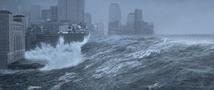
Don't Bring Me Down…
OK, I'll let you in on my secret theory: I believe that we humans find doomsday scenarios so freakin' interesting (look at "The Day After Tomorrow", or that 80's nightmare inducer, "The Day After") because we want to know the worst case scenario so we can start planning for it. Seriously, after September 11th, who didn't have an escape route from the city planned out? Lord knows I did — I even told all my friends, so they'd know where to come find me.
So maybe I have a perverse predilection with worst-case scenarios, and you should take everything I'm about to tell you with a grain of salt. A giant, Rainier-sized grain of salt. But at the very least, it'll get you thinking, might possibly explain why the fuck we're nation-building in Iraq, and get you to switch to a hybrid or biodiesel car (read igChar's fantastic article!)
Here's my latest sleep-killing end-of-the-world-as-we-know-it (earthquakes, birds, and snakes, and aeroplanes…) scenario: it's called the Peak Oil theory (www.PeakOil.org, www.peakoil.net, www.peakoil.com, or Google search "peak oil" and freak out at the number of hits). The peak oil theory is, simply put, the proposition that global oil production will one day (soon) peak, and then begin an inevitable decline due to overconsumption of this finite resource.
Beware the Peak
The theory was first proposed by the late Dr. M. King Hubbert, a geophysicist, who was well known as a world authority on the estimation of energy resources and on the prediction of their patterns of discovery and depletion. Hubbert realized that U.S. oil production in the 1950's, when the U.S. was the world's top oil producer, followed the upward slope of what appeared to be a bell curve — one that he projected would peak, and then begin to decline.
His prediction in 1956 that U.S. oil production would peak in about 1970 and decline thereafter was scoffed at, and Hubbert was blackballed and fired from his job. His analysis has since proved to be remarkably accurate, as the Energy Crisis of the early 70's revealed, when the U.S. indeed hit its peak oil production and began the era of U.S. reliance on foreign oil.

Many prominent scientists and economists note that world oil production is following the same Hubbert curve, with an anticipated peak of 2000-2025, depending on estimates of oil reserves and undiscovered resources. Some more alarming recent estimates are that the oil peak has been passed, and we will only begin to realize this within the next several years. The graph above (from peakoil.net) demonstrates the latest thinking — that the global oil peak is due in 2008 — and that even the Middle East, the Arctic, deepwater drilling, and natural gas can only sustain us for another decade or so.
Exploration and Lag Time — Huh?
Now, many folks will tell you that there is nothing to worry about — that there is always a lag time between the discovery of oil resources and its subsequent extraction. See, the problem with this assurance is that we haven't discovered any new easy to extract resources in years.
What does "easy-to-extract" mean? Well, on the upward slope of the curve, every drop of oil is both easier to extract and cheaper to extract than the drop prior (think freshman economics — once the infrastructure is in place, subsequent production is cheap). After the peak of global oil production, every drop of oil is harder to extract and more expensive to extract than the prior drop. This is a production nightmare. If this was candy bars, you'd stop making them and switch to something else. This graph (also from peakoil.net) illustrates the growing gap between new oil discoveries and current production.

So here's something to think about — the world's two largest oil fields are in Iraq and Saudi Arabia; a point that some claim explains the ulterior motives of the current Iraq war as a means of securing U.S. access to these resources, as they will be the last "easy to extract" oil resources. This means that when the rest of the world has been pumped dry, Saudi Arabia and Iraq will be the last two places pumping. Call me a genius, but I kinda think whoever is in control of those places is in the position to make a shitload of money, and will have a lot of friends, if you know what I mean.
So Freakin' What? I'm Hungry!
Again resorting to basic economics, oil production decline will result in extreme price inflation, territorial disputes, and a severe limiting pressure on global population. Why? For one, the entire agribusiness industry is oriented around cheap oil, including the use of petrochemical insecticide and fertilizer, delivery, and packaging.
Play a fun little game with me: go into your local supermarket (as crunchy granola hippy-dippy as you want) and look at the products on the shelves. How many are wrapped in, encased in, or somehow utilize plastic? A lot, huh? Maybe even most of them. Well, friends, THAT'S ALL OIL. Most synthetic polymer materials are made from petroleum byproducts and used in everything from polyester clothing to vinyl siding on homes to the plastic film on compact-disc covers. The price of high-density polyethylene, used in such common products as plastic milk containers and trash bags, has risen by 20 percent since early 2003 and is at historic highs (from builderonline.com).
How 'bout the produce section? All those lovely fruits and vegetables were grown in farms that use chemicals made from petroleum products. "Ah ha!" you say — not the organics! Yes, but what about the pumps that water the fields? What about the farm machinery that plows, tills, and harvests? What about the lovely big rig that trucks it all to your PCC?
Do you see where I'm going with this? If oil cost $200 per barrel (it's about $40/barrel right now, a ten-year high), and gasoline is $20 per gallon — who pays for trucking your food to you? Farming has never been a get-rich proposition, and it's even worse now. What if gas is $100 per gallon? I know it's nutty to think about — but if we run out of it, who can honestly say how much oil and gas will ultimately cost?
Now — to make things worse: world population is increasing, and we've never done a good job of feeding everyone. But after the peak, world oil falls at roughly the same rate it rose. Simply put — the world will have access to as much oil in 2025 as it did in 1975 (assuming a Y2000 peak). However, oil will be significantly more expensive, and the world population will have doubled from ~4 billion to ~8 billion people. Collapse of food production and delivery resulting in massive starvation in third- and second-world countries is not a far-fetched possible result. People will flee whole countries, looking for food. Where will those refugees go? Kent? Kalamazoo? Kansas? Kentucky?
And now to cap off the horror in our frightening new world of terror. Can you imagine what we'll say to Brazil or Botswana or Bangladesh when it becomes clear that we — the U.S., Russia, Europe, and Japan — have used up all of this precio
us resource before they ever had a chance to get to their feet and become self-sufficient? Don't you think they might be pissed — and that suddenly the poor starving nations of the world will rightly feel that they've been fucked out of an entire century of cheap development? Well, maybe I can't predict the future but I'm pretty sure they will, and you know — they'll be completely right.
This is The End, My Only Friend… The End.
Normally I like to end on an up note — with lots of suggestions for what you can do. But you know, I'm still freaking out about this one — I don't know what to do, other than tell you to switch to biodiesel or buy a hybrid car. Maybe if enough of us do that, the oil companies will get the message, and car companies will get the message. Kind of like everyone going low-carb at the same time: the potato farmers are freaking out, and Coca Cola suddenly has low-carb Coke.
But this is more than conservation — this is a giant, unanswered question: how do we switch the entire world over from an oil economy to a non-oil economy — and what the hell does a non-oil economy look like, anyways? And once we do it, how the hell do we tell six billion people we screwed them out of a hundred years of the American dream, cause we were busy driving our SUVs to the market for plastic encased crappy food?
Again, I don't know the answers, but this is one end-of-the-world nightmare scenario that seems more and more real to me, and I just want to wake up.
Resources
Three ImaginaryGirls.com wholeheartedly supports this report but opinions expressed are the author's and do not necessarily reflect opinions or policies of the girls {although, as igLiz says, "It doesn't necessarily not reflect our opinions…"}